
When a negotiation is not going well, it is tempting to hand it over to someone else. It feels like the professional choice: let an expert deal with it. But in my experience, that is not always the best approach, particularly when you will continue working with the other side after the deal. Sending someone in your place may create problems instead of solving them.
What you may need is not someone to replace you at the table, but a negotiation coach who helps you prepare to return to the conversation yourself. The difficulty is that people often confuse three different types of professional support: a negotiation coach, a commercial negotiator (or negotiation consultant) and a lawyer. They all work with negotiations, but they do different things, and the right choice depends on what makes your negotiation difficult, what is at stake, and what you need to achieve beyond the immediate agreement.
What Is the Difference Between a Negotiation Coach, a Lawyer and a Commercial Negotiator?
All three professionals can help with negotiations, but the main differences are who conducts the discussion and who can provide legal advice.
A negotiation coach helps you prepare to negotiate on your own. You remain responsible for the conversation, while the coach works with you before each round and helps you assess what happened afterwards.
A commercial negotiator, sometimes called a negotiation consultant, negotiates on your behalf. You agree on the scope of their authority, and they deal with the other side on price, volumes, delivery terms or other commercial matters. Procurement specialists, business brokers and industry advisers often perform this role.
A lawyer advises on your legal rights, obligations and risks. Depending on the circumstances, the lawyer may advise you behind the scenes while you negotiate or represent you directly.
| Negotiation coach | Commercial negotiator/ negotiation consultant | Lawyer | |
| Who speaks to the other side | You | The negotiator, on your behalf | You, or the lawyer on your behalf |
| What you get | A negotiation strategy and preparation to carry it out under pressure | Negotiation of commercial terms within an agreed mandate | Legal advice and, where needed, representation |
| Works best when | You need to maintain the relationship and want to negotiate yourself | The mandate is primarily commercial, often involving a one-off transaction | Legal rights, claims or significant contractual obligations are involved |
| Legal advice | No | No | Yes |
The last row is particularly important. A commercial negotiator may obtain a good price, but cannot advise you on the legal obligations you are accepting in exchange. Neither can a negotiation coach. If the negotiation involves significant legal consequences, you need a lawyer involved, regardless of whether you conduct the discussion yourself or engage someone else to do it.
A lawyer who focuses on negotiation and settlement work is sometimes described as negotiation counsel. This is not a separate profession, but a particular approach to legal representation that combines legal assessment with negotiation strategy.
None of these professionals is simply a cheaper substitute for another. They address different needs, and a commercial negotiator may be a sensible choice for a one-off transaction involving primarily business terms, particularly where you do not need to maintain a relationship with the other side afterwards. But when the relationship will continue, you need to consider more.
When Does Sending Someone Else Make the Negotiation Worse?
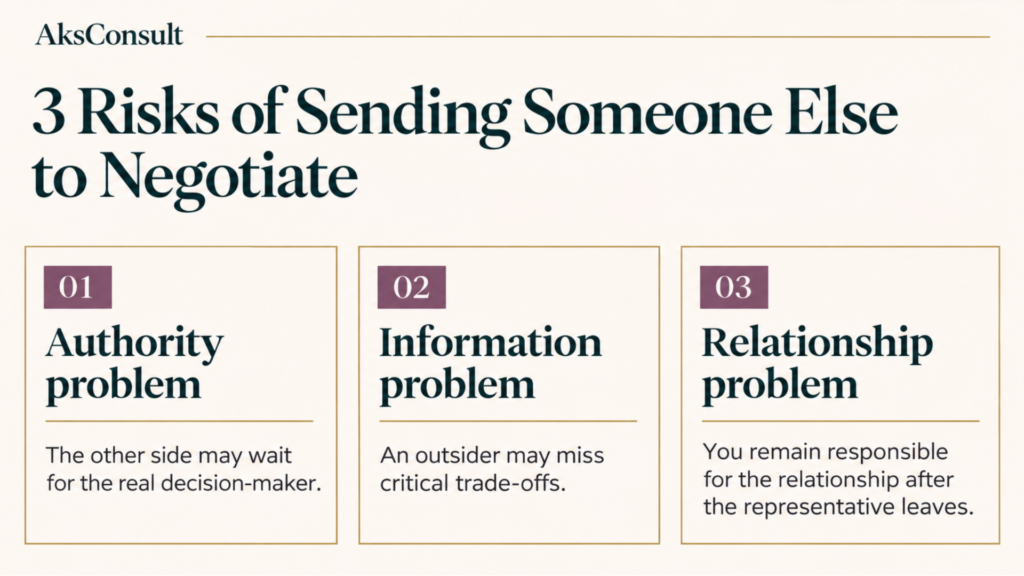
It is easy to assume that a professional negotiator or lawyer will obtain a better result because negotiating is part of their job. Sometimes that is true. But when you have an ongoing relationship with the other side, representation can create three difficulties that are worth considering.
The authority problem
A representative can only make commitments within the authority you have given them, and the other side knows this. They may hold back their most important concessions until they can speak directly with the person who makes the final decisions. This can slow the process, as every significant proposal may need to be referred back to you, discussed and approved before the negotiation can move forward.
Bringing in a representative may also change how the other side views the relationship. If you have dealt directly with a supplier for years and suddenly bring in a professional negotiator, the supplier may wonder what has changed and why you no longer want to speak to them yourself. Depending on the circumstances, that may not be the message you intended.
The information problem
You know your business in ways that an external representative may never fully understand. Good negotiations often involve trade-offs: giving the other side something that costs you relatively little in exchange for something you value much more.
You may be flexible on delivery dates, but payment terms are critical to your cash flow. Or a particular contractual requirement may look important on paper but create little practical difficulty for your operations team. An experienced negotiator will try to understand these priorities during preparation, but some details are always hard to communicate in a briefing. Those details can make a real difference when an unexpected proposal comes up during the conversation.
The relationship problem
Your representative leaves when the negotiation is over, but you remain responsible for the relationship. You will have to work with the supplier, business partner or investor, implement the agreement and deal with any tensions that arose during the discussion.
Perhaps the representative took a particularly aggressive approach, or perhaps the other side made concessions but now feels that the relationship has become adversarial. Even if the immediate agreement is satisfactory, you may have to deal with the consequences. Consider the next contract renewal: will the supplier expect to deal with the same representative again? If not, will they wonder why you needed one last time?
There is no universal answer. Sometimes representation is necessary, and the benefits clearly outweigh these disadvantages. But the effect on the relationship should factor into your decision, not something you discover afterward.

Ready to transform your disputes & negotiations?
Book Free 20-Minute ConsultationWhat Does Executive Negotiation Coaching Involve?
Executive negotiation coaching prepares you for a specific high-stakes conversation you will lead. The work happens before the meeting and, when negotiations involve several rounds, between rounds.
We focus on two things. The first is the substance of the negotiation: what the other side really wants, what your alternatives are if you cannot reach an agreement, where there might be opportunities for trade-offs, and what you are prepared to concede. The second is how you behave when the conversation becomes difficult.
Most people have patterns that affect their negotiations. Some explain themselves too much, give a good answer, then keep talking until they weaken their own position. Others concede too quickly because they want the tension to end, become defensive when challenged, or hold on to a particular demand even when a different arrangement might better serve their interests.
These patterns can be costly, especially when the other side recognizes them and knows how to apply pressure. Coaching helps you identify these reactions, understand what triggers them and practise responding differently.
The other side does not need to know you have worked with a coach. They simply see someone who is better prepared, asks more useful questions, and is less likely to abandon a position under pressure.
There is also a longer-term benefit. When someone negotiates for you, they may help you obtain a better agreement, but your own negotiating skills do not necessarily improve. With coaching, you develop skills you can use in the next negotiation and the one after that. You also continue dealing directly with the people whose cooperation you will need in the future.
What Does Negotiation Coaching Look Like in Practice?
Consider a professional who has just received a job offer. The position is attractive, the company seems like a good fit, and the candidate is excited about the opportunity. But the proposed salary is lower than expected, the vacation entitlement is limited, and the candidate would prefer more flexibility in their working arrangements.
The candidate wants to negotiate, but hesitates. What if asking for more money makes the employer reconsider the offer? What if the hiring manager thinks the candidate is difficult or ungrateful? After several rounds of interviews, the candidate does not want to risk losing the opportunity.
This is a situation where negotiation coaching can be particularly useful. Candidates usually handle job offer negotiations themselves. The challenge is not necessarily finding someone to negotiate on their behalf, but preparing them to have the conversation themselves.
We start by identifying what matters most to the candidate. Is the priority a higher base salary, a signing bonus, additional vacation, flexible working arrangements or opportunities for professional development? Which conditions are essential, and where is there room for flexibility?
We also consider the candidate’s alternatives and the employer’s possible constraints. The employer may have a fixed salary range but greater flexibility on other terms. Understanding these possibilities helps the candidate avoid treating the negotiation as a single question of whether the employer will agree to a higher number.
Next, we work on how to communicate the request. The candidate needs to express genuine enthusiasm for the role while making a clear and confident proposal. We discuss how to support the request with relevant experience, responsibilities, market information and the value the candidate expects to bring to the organization.
The wording matters. A candidate who feels uncomfortable asking for more may begin with a long apology or undermine their own proposal before the employer has even responded. Others may take an unnecessarily confrontational approach, particularly if they feel the initial offer undervalues their experience.
Coaching helps the candidate find a way to be both clear and constructive. We prepare for possible objections, such as “This is the maximum salary we can offer” or “We need everyone at this level to have the same conditions.” Rather than immediately accepting the answer or repeating the original demand, the candidate can learn to ask questions, explore the employer’s constraints and consider alternative arrangements.
We also work on the emotional side of the conversation. For some candidates, the fear of losing the offer makes it difficult to negotiate at all. For others, a disappointing salary figure becomes a judgment about their professional worth. Recognizing these reactions can help the candidate make decisions based on their actual interests rather than the emotions of the moment.
Finally, we practise the conversation through role-play. The candidate can try different ways to open the discussion, respond to resistance, and make a counterproposal. Sometimes the most important skill is learning to make a reasonable request and then stop talking, rather than filling the silence with explanations or concessions.
You also need to consider the relationship. The candidate is not negotiating with a stranger they will never see again. They may soon be working with the hiring manager and other people involved in the decision. The objective is therefore not simply to obtain better terms, but to negotiate in a way that supports a constructive working relationship from the beginning.
Negotiation coaching does not replace legal advice. If the candidate needs advice on the legal terms of the employment agreement, such as termination provisions, restrictive covenants or other contractual obligations, that requires a separate legal engagement. I provide legal advice through my law practice, ArbitraLex, including on employment-related negotiations where the issues fall within my professional competence.
The objective of coaching is not to give the candidate a script to memorize. It is to help them understand their priorities, develop a strategy, prepare for difficult responses and approach the conversation with greater confidence. These are skills they can use not only for this job offer, but also in future salary reviews, promotion discussions and other workplace negotiations.
What Does a Coach With a Legal Background Add?
I have more than 17 years of experience as a lawyer, working on complex commercial disputes. That experience influences how I approach negotiation coaching.
Many commercial disputes trace back to something that happened during negotiations: a promise made in an email, a concession later interpreted as an admission, or a deadline accepted without considering whether it could realistically be met. As a negotiation coach, I do not provide legal advice, but my legal background helps me recognize when a discussion is moving into territory that may require legal advice.
If I see that a proposed concession could raise questions about contractual obligations or liability, I will recommend addressing those questions with a lawyer before the next negotiation round, rather than after the terms have been agreed.
My background is also useful when the other side brings lawyers to the table. Legal arguments can sometimes be used as negotiation pressure. Understanding the difference between a genuine legal issue and a negotiating position helps you identify the right questions to ask legal counsel.
I can also help clients translate legal advice into a practical negotiation strategy. A lawyer may explain what the contract permits or what risks a particular proposal creates. The client still needs to decide how to communicate their position, respond to objections and manage the relationship. Legal advice and negotiation coaching serve different purposes, but they work particularly well when they are coordinated.
These remain separate professional services. Through AksConsult, I provide non-legal negotiation coaching and training. Where a client also requires legal advice or representation, I may provide those services through ArbitraLex under a separate legal engagement, where the matter falls within my professional competence.
When Does It Make Sense to Have a Lawyer Negotiate for You?
Coaching alone isn’t enough in some situations. If you are negotiating the settlement of a legal claim, entering into significant contractual obligations, or dealing with questions about liability or enforceability, you need legal advice. Depending on the circumstances, it may also make sense for the lawyer to negotiate on your behalf.
For example, a dispute may become highly personal. If every conversation turns into an argument about past grievances, an experienced representative may help move the discussion back towards the issues that need to be resolved. Another is a one-off transaction where you do not need to preserve a continuing relationship with the other side, such as selling an asset to a buyer you are unlikely to deal with again.
Professional representation can also be valuable when the other side has a team of experienced lawyers or negotiators, and you lack comparable expertise. For example, a founder negotiating with the procurement department of a large company may be dealing with professionals who negotiate similar contracts every week.
If your primary objective is to reach a negotiated settlement rather than pursue litigation, it is also worth considering a lawyer’s approach to negotiation. Negotiation counsel combines legal analysis with negotiation strategy, including communication, the interests behind the parties’ positions, and the dynamics of conflict. A lawyer with this focus may be a suitable choice even where the dispute arises in a particular area of law, provided they have the competence to address the legal issues involved.
The right approach depends on the nature of the transaction, the legal risks, the people involved and whether you would benefit more from professional representation or from preparing to conduct the discussion yourself.
I am also a practising lawyer and provide negotiation counsel services separately through my law practice, ArbitraLex. Through ArbitraLex, I can assess the legal aspects of a negotiation, develop a strategy that accounts for those issues, and prepare clients to lead discussions themselves or negotiate directly on their behalf.
You can read more about negotiation and settlement counsel at ArbitraLex.
What If the Problem Is Bigger Than One Negotiation?
Sometimes the difficulty is not limited to one conversation. Perhaps several people in your organization struggle with the same demanding customer, or different teams repeatedly face similar procurement tactics, difficult internal discussions or disagreements over resources.
In these situations, coaching one person may not be enough. The organization may benefit more from developing negotiation skills across the team through corporate negotiation training.
Some situations also call for neither coaching nor representation. If both sides want to preserve a commercial relationship but can no longer communicate productively, mediation may help. A mediator does not negotiate for either party. Instead, the mediator facilitates a structured discussion and helps the parties work towards an agreement they develop themselves.
How Do You Decide Whether You Need a Coach or a Lawyer?
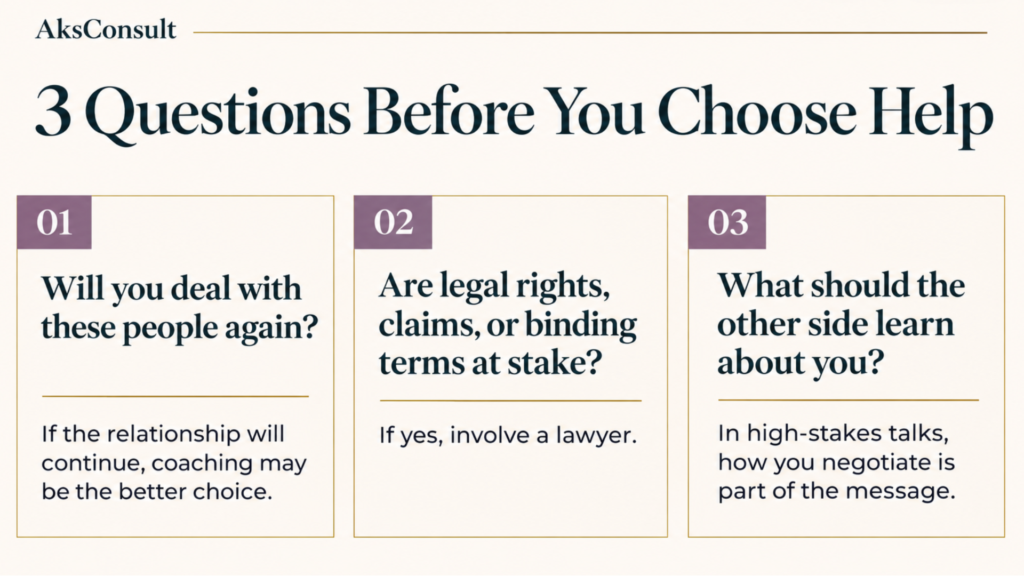
I would start with three questions.
Will you deal with these people again?
If the relationship will continue, consider whether you would benefit more from preparing to lead the negotiation yourself. Coaching allows you to develop your approach while maintaining a direct relationship with the other side.
Are legal rights, claims or binding terms at stake?
If yes, you need legal advice, regardless of who negotiates. Depending on the circumstances, the lawyer may advise you behind the scenes or represent you directly.
What should the other side learn about you?
This question matters most for founders and executives. When a founder meets an investor, the conversation is about valuation and terms, but the investor is also watching how the founder holds a position under pressure, makes decisions and handles disagreement. Those impressions often outlast the term sheet.
If someone else conducts the whole negotiation, the process may feel easier in the moment. But the founder loses the chance to show those qualities directly.
People often look for professional help when they are frustrated or exhausted by a negotiation. At that point, handing it over can seem especially attractive. But sometimes the more valuable investment is preparing to return to the conversation yourself, with a clearer strategy and greater confidence in your ability to handle it.
Frequently Asked Questions
What happens in a negotiation coaching session?
We start by reviewing your situation: who you are negotiating with, the history of the relationship, what is at stake and what has happened so far. We then develop a strategy, prepare for likely objections and pressure tactics, and practise difficult parts of the conversation through role-play. If negotiations involve several rounds, we review what happened and adjust the strategy before the next meeting.
What is the difference between a negotiation coach, a commercial negotiator and a lawyer?
A negotiation coach prepares you to negotiate yourself, while a commercial negotiator (also called a negotiation consultant) negotiates business terms on your behalf within an agreed mandate. A lawyer advises on legal rights, obligations and risks and may also negotiate on your behalf. Negotiation counsel is a lawyer whose work emphasizes negotiation strategy and reaching agreements. Non-lawyer coaches and commercial negotiation consultants cannot provide legal advice.
Can a negotiation coach negotiate on my behalf?
Negotiation coaching is designed to prepare you to negotiate yourself, not to have the coach act as your representative. If you want someone to negotiate on your behalf, you may need a commercial negotiator or negotiation consultant, or, where legal issues are involved, a lawyer providing negotiation counsel services.
Does a negotiation coach give legal advice?
No. Negotiation coaching covers preparation, strategy, communication and negotiating behaviour. Questions about contractual rights, liability, enforceability or the legal consequences of proposed terms require legal advice. A coach with a legal background may help you identify when you need that advice.
How do I choose a negotiation coach?
Look for someone who takes the time to understand your specific situation before recommending techniques. A useful coach should ask about the history of the relationship, the other side’s interests, your alternatives, previous concessions and what makes the conversation difficult for you. Practical experience, the ability to challenge your assumptions and opportunities to practise through realistic role-play are also important.
Can I combine negotiation coaching with legal advice?
Yes. Negotiation coaching and legal advice can complement each other. For example, you may want coaching to prepare for a job offer negotiation while also obtaining legal advice on particular provisions of the employment agreement. I provide non-legal negotiation coaching through AksConsult and legal services separately through ArbitraLex, where the matter falls within my professional competence. Each service has its own scope and professional framework.
Does legal privilege protect coaching conversations?
Negotiation coaching should not be assumed to be protected by solicitor-client privilege. Coaching conversations may be subject to confidentiality obligations, but confidentiality and legal privilege are not the same thing. Whether privilege applies depends on the circumstances and the purpose of the communication. If a negotiation involves potential litigation or arbitration, or if privilege matters, seek legal advice on how to handle communications.
Is it a sign of weakness to work with a negotiation coach?
No. Coaching happens before and between negotiation rounds, and the other side doesn’t need to know about it. What they see is someone who is better prepared, more consistent, and better able to handle pressure.
Is negotiation coaching only for inexperienced negotiators?
No. Experienced executives and business owners can benefit from coaching, particularly when dealing with a difficult counterpart, a high-stakes decision or a relationship they cannot afford to damage. Experience does not eliminate personal negotiating habits, and even skilled negotiators may benefit from an outside perspective.