
The Lifecycle of a Commercial Dispute
Most commercial disputes do not begin in arbitration or court. In practice, they take shape much earlier – during negotiations, in risk allocation, in unclear drafting, and in the internal dynamics of the organisations involved.
A conflict is not an isolated event. It is a process – either managed or unmanaged.
Recognising this distinction is critical. The earlier a company intervenes, the more control it retains over cost, timing, and outcome.
When disputes reach formal proceedings, parties often say:
“We didn’t expect it to escalate this far.”
In reality, escalation is usually gradual and identifiable.
A simplified lifecycle looks like this:
Prevention → Tension → Escalation → Formal Dispute → Decision
The question is not whether conflict can be eliminated entirely.
The question is at what stage it is addressed.
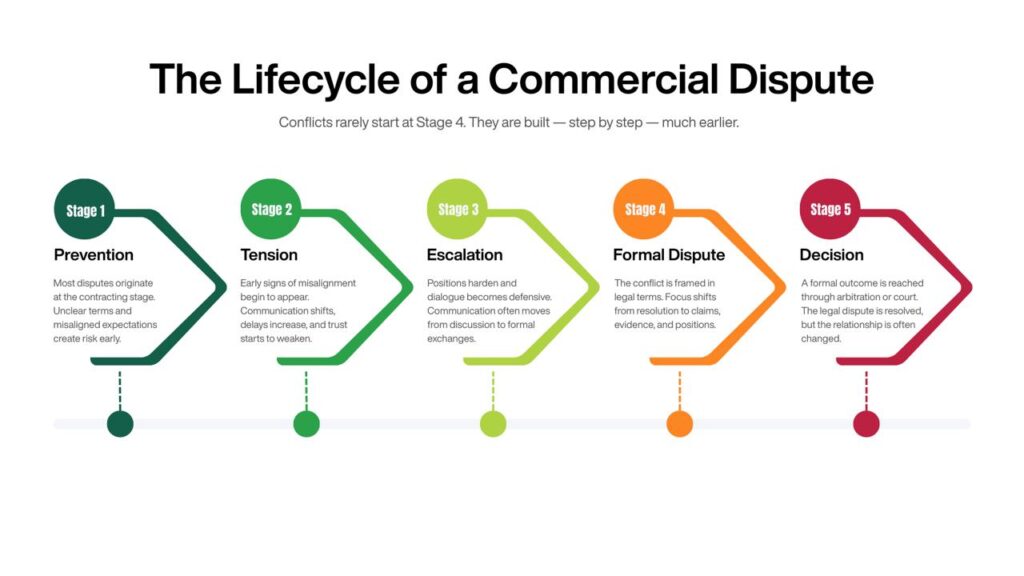
Stage I. Prevention: Strategic Preparation and Contract Architecture
Most disputes are embedded in the contract stage – when no dispute yet exists.
A common error is to treat negotiations as a discussion of commercial terms rather than the structuring of risk.
A surface-level approach focuses on:
- price;
- timelines;
- headline obligations.
A strategic approach asks a different question:
What happens if performance fails - and how precisely have we allocated that risk?
Contract Clarity as a Risk-Control Mechanism
A significant percentage of commercial disputes arise not from misconduct, but from ambiguity.
At the contracting stage, parties operate in a cooperative environment. Alignment appears natural. Future conflict feels remote. That is precisely when unclear language enters the agreement:
- broad or undefined terms;
- subjective performance standards;
- incomplete termination mechanisms;
- unresolved contingencies postponed “for later.”
When tension later emerges, those ambiguities become leverage points.
Each side relies on its own interpretation. The contract ceases to stabilise the relationship and instead becomes the battleground.
Effective prevention therefore requires:
- precise drafting;
- objective performance metrics;
- clearly articulated consequences for breach;
- confirmation that business teams – not only lawyers – understand how the contract operates in practice.
A recurring problem in complex transactions is this: the clause exists, but no one can clearly explain how it is meant to function. In a dispute scenario, that uncertainty accelerates escalation.
Strategic Negotiation Preparation
Prevention extends beyond drafting. It requires structured preparation, including:
- defined objectives (aspirational, realistic, minimum acceptable);
- viable alternatives if agreement fails (BATNA);
- a realistic bargaining range (ZOPA);
- scenario planning for non-performance;
- identification of underlying commercial interests.
At the same time, contracts are negotiated by people, not institutions.
Even in cooperative negotiations, the following dynamics often operate beneath the surface:
- concern about setting precedent;
- internal pressure not to appear overly flexible;
- board or shareholder expectations;
- inter-departmental competition;
- differences in corporate culture.
Parties sometimes avoid difficult clauses not because they agree, but because they prefer not to intensify negotiations at that moment. What appears commercially efficient in the short term may create structural vulnerability later.
Prevention does not mean avoiding friction. In many cases, addressing difficult issues early is precisely what reduces future exposure.
A well-structured contract is not merely documentation. It is a forward-looking risk management instrument.
Stage II. Managed Escalation
Tension in commercial relationships is not unusual. Escalation becomes problematic when it goes unrecognised.
Escalation rarely occurs abruptly. It is typically preceded by identifiable signals:
- a shift in tone;
- hardened language replacing problem-solving;
- repeated delays;
- overt displays of leverage;
- public positioning within the organisation;
- transition from direct discussion to extensive written exchanges.
The move from conversation to documentation is particularly telling. When parties begin formalising every communication, it often reflects declining trust and defensive positioning.
At this stage, the dispute remains manageable – but only with deliberate intervention.
Legal Strength vs. Organisational Reality
It is not uncommon for one party’s legal position to be objectively stronger. Yet legal strength does not automatically produce resolution.
Escalation is frequently driven by:
- reputational concerns;
- fear of internal loss of authority;
- previously declared public positions;
- status dynamics within leadership teams;
- shareholder or board pressure.
In practice, personal and organisational factors often outweigh purely legal analysis.
A rational solution may exist. The willingness to adopt it may not.
Cultural Dynamics
Escalation is also shaped by negotiation culture. Direct disagreement may be routine in one environment and confrontational in another. In cross-border disputes, misreading cultural signals can accelerate breakdown.
What one party perceives as assertive but commercially reasonable, another may interpret as final and adversarial.
Managing escalation requires recognising these dynamics rather than reducing the dispute to a binary question of legal entitlement.
Intervention at this stage typically involves:
- re-establishing structured dialogue;
- separating legal analysis from emotional reaction;
- assessing internal decision-making pressures;
- understanding what signals are being sent – and to whom.
Failure to address escalation structurally usually leads to formalisation.
Stage III. Mediation as a Structured Intervention
Mediation is neither mandatory nor universally appropriate. It becomes relevant when direct communication between parties is no longer productive.
By the time mediation is considered, discussions often have deteriorated into repetition, defensiveness, and positional rigidity.
The mediator’s function is not to decide the dispute, but to restore process discipline and facilitate structured engagement.
Depending on the model, the mediator may either:
- facilitate communication without expressing views on merits; or
- provide evaluative feedback on strengths, weaknesses, and risk exposure.
In some contracts, mediation is embedded as a mandatory pre-litigation mechanism. In others, it is a strategic choice.
Conditions Favouring Effective Mediation
Mediation tends to be effective where:
- parties retain baseline commercial rationality;
- reputational exposure is material;
- there is value in preserving the relationship;
- litigation or arbitration costs are disproportionate;
- decision-makers with full authority are present.
Authority is critical. Without genuine decision-making power at the table, mediation frequently becomes procedural rather than substantive.
Structural Limits of Mediation
Mediation may be ineffective where:
- the process is used to delay;
- parties lack autonomy to resolve the dispute;
- positions are publicly entrenched;
- the dispute is framed as a matter of status rather than substance;
- there is significant inequality in negotiating power.
A skilled mediator can mitigate – but not eliminate – serious structural imbalance.
Mediation presupposes at least minimal willingness to resolve the matter. Without that baseline, it is unlikely to succeed.
Practical Assessment Framework
| Mediation tends to succeed when | Mediation tends to fail when |
|---|---|
| Commercial rationality remains | Process is used tactically |
| Decision-makers are present | No authority to settle |
| There is interest in resolution | Positions are entrenched |
| Escalation risk is high | Significant power imbalance |
| Dialogue can still be structured | Parties are unwilling to compromise |
Legal strength alone does not ensure settlement. Internal politics, precedent concerns, reputational risk, and leadership psychology frequently influence the outcome more than doctrinal analysis.
When those forces dominate, the dispute moves toward formal determination.
Stage IV. Arbitration: Formal and Binding Determination
When negotiation and mediation fail, the dispute transitions into formal adjudication.
Arbitration is not an extension of negotiation. It is a structured process culminating in a binding decision.
Arbitration provides:
- neutral adjudication;
- procedural certainty;
- binding determination;
- enforceability through applicable legal regimes.
In international disputes, enforceability is supported by the New York Convention. Domestically, it is governed by relevant arbitration statutes.
Arbitration delivers legal certainty. It resolves liability, breach, and consequences. It closes the legal question.
What Arbitration Does Not Resolve
Arbitration does not restore trust.
By the time parties reach arbitration, collaborative dialogue has usually broken down. In many cases, arbitration marks the practical end of the commercial relationship.
In long-term projects or complex infrastructure arrangements, cooperation may continue despite arbitration. In such situations, arbitration resolves the legal dispute but does not automatically repair accumulated tension.
At the same time, arbitration does not inevitably destroy relationships. In certain contexts, a definitive ruling reduces uncertainty and enables parties to move forward.
Strategic vs. Reactive Arbitration
Arbitration may be a strategic decision – where independent determination is required – or a reactive consequence of unmanaged escalation.
Companies that integrate arbitration into a broader conflict lifecycle:
- evaluate evidentiary strength early;
- model financial exposure;
- assess reputational implications;
- align dispute strategy with commercial objectives.
In that framework, arbitration is not the beginning of crisis – it is the final stage of structured resolution.
The Economics of Escalation
Escalation consumes capital – financial and managerial.
The later intervention occurs, the greater the:
- legal expenditure;
- management distraction;
- opportunity cost;
- reputational exposure;
- duration of uncertainty.
Commercial arbitration frequently spans 12–18 months, and complex proceedings may extend further. Court litigation in many jurisdictions may last several years.
The result is often prolonged uncertainty, constrained capital allocation, and sustained executive attention diverted from core operations.
Preventing unnecessary escalation is not a matter of accommodation.
It is a matter of disciplined resource management.
An Integrated Conflict Strategy
Negotiation, mediation, and arbitration are not isolated services. They are phases within a single continuum.
- Early strategic preparation reduces structural vulnerability.
- Timely escalation management preserves optionality.
- Effective mediation clarifies risk and informs subsequent positioning.
- Structured arbitration delivers finality when required.
Mature organisations treat conflict management as part of enterprise risk governance.
Reactive vs. Lifecycle Approach
| Reactive Model | Lifecycle Model |
|---|---|
| Responds to crisis | Manages progression |
| Focuses on “who is right” | Focuses on exposure and risk |
| Escalates emotionally | Intervenes structurally |
| Uses tools in isolation | Integrates stages deliberately |
Conclusion
Commercial disputes operate at the intersection of legal doctrine, commercial strategy, organisational dynamics, and human behaviour.
Reducing them to a single dimension – legal, financial, or emotional – distorts the analysis.
Understanding the lifecycle of conflict allows organisations to:
- intervene earlier;
- preserve optionality;
- control cost and duration;
- align dispute strategy with business objectives.
Ultimately, it is not about avoiding conflict. It is about managing it before it dictates the direction of the business.